

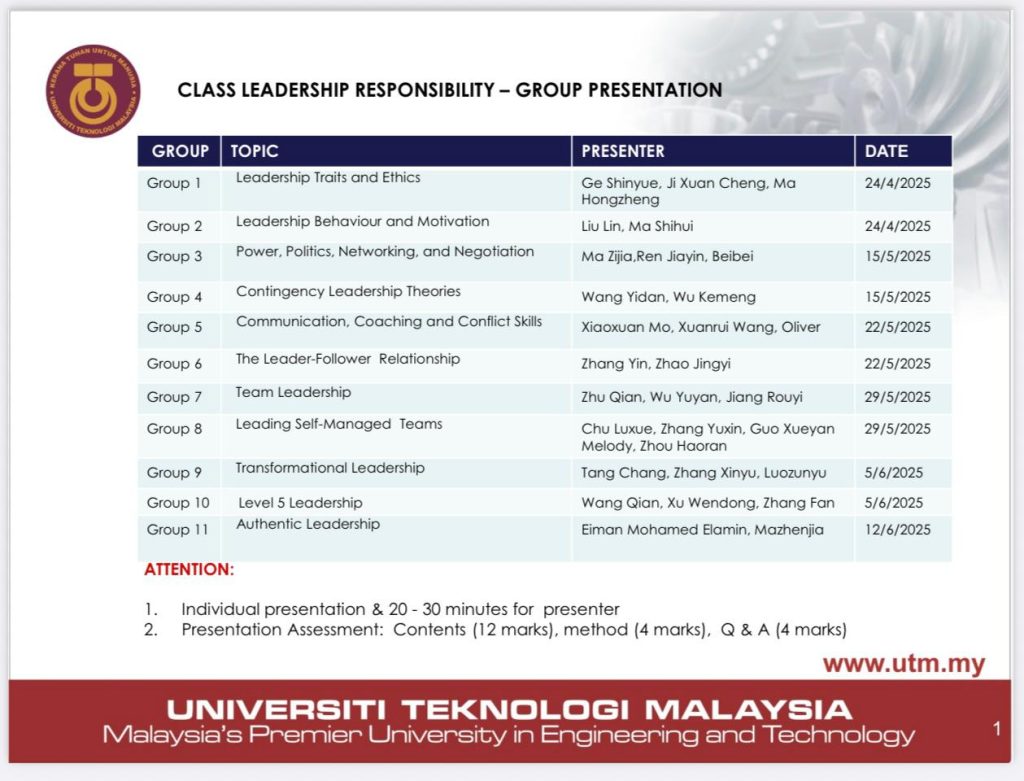
Week 1 – Introduction to dynamics of leadership course
Week 2 – Introduction to leadership
Week 3 – Leadership traits and ethics
Week 4 – Leadership behavior and motivation
Week 5 – Power, politics, networking and negotiation
Week 6 – Contingency leadership theories
Week 7 – Communication, coaching and conflict skills
Week 8 – Mid-sem break
Week 9 – Sharing experience – talk by an expert
Week 10 – The leader-follower relationship
Week 11 – Team leadership
Week 12 – Leading self-managed team
Week 13 – Transformational leadership
Week 14 – Level 5 leadership
Week 15 – Authentic leadership
Before enrolling in UHPS 6013, my understanding of leadership in education was limited to the roles of principals, senior teachers, or administrators who managed school operations and enforced rules. I perceived leadership mainly as a top-down process where authority was exercised to maintain discipline, ensure performance, and manage classrooms or institutions. I had not fully realized how deeply leadership principles could influence teaching effectiveness, student engagement, team collaboration among educators, and school culture overall.
I also assumed that being a good teacher automatically translated into being a good leader. I did not yet understand the nuances of emotional intelligence, situational leadership, or how essential influence, communication, and ethical judgment are in shaping successful educational environments.
Through topics such as Trait Theory, Behavioral Models, Contingency Approaches, and Team Leadership, I learned that successful educational leaders are not just managers of instruction, but facilitators of vision, collaboration, and change. I have come to appreciate how leadership in schools is both relational and situational—requiring empathy, self-awareness, adaptability, and clear communication.
For example, the Situational Leadership Model helped me understand how to support both high-performing and struggling students through tailored guidance. The Conflict Management and Coaching sessions equipped me with tools to resolve misunderstandings among students or colleagues constructively. Meanwhile, concepts like the Pygmalion Effect and Leader-Member Exchange reminded me that believing in students’ and teachers’ potential can directly elevate performance and motivation.
The expert talks enriched the theory with practical applications, particularly in educational settings. I now realize that leadership in education requires creating a supportive environment, encouraging innovation among teachers, and building trust-based relationships with students, parents, and colleagues. It is not about having all the answers—but about asking the right questions and empowering others to grow.
UHPS 6013 has shifted my understanding of leadership from a formal role into a deeply personal and professional responsibility, especially in the education field. I feel more prepared to serve as a role model in the classroom, a collaborator among teaching peers, and a change agent within school systems. This course has inspired me to become not just a better teacher, but a more intentional, ethical, and empathetic leader—committed to lifelong learning and the holistic development of others.

This week’s lecture introduced the fundamental concepts of leadership, setting a strong foundation for understanding the dynamics and responsibilities of effective leaders. The session, conducted by Assoc. Prof. Dr. Jamilah Ahmad, was insightful, covering essential theories and frameworks that define modern leadership.
One of the key takeaways was the definition of leadership as an influencing process where leaders and their followers work together to achieve organizational goals through change. We explored five key elements of leadership: People, Influence, Change, Organizational Objectives, and Leader-Follower Relationships. These elements illustrate how leadership is not just about authority, but about motivating and guiding others toward a shared vision.
The lecture also emphasized the importance of influence—the ability to communicate ideas, gain support, and motivate people. This element is at the heart of all leadership activity, distinguishing leaders from mere managers. The comparison between leaders and managers was particularly eye-opening; leaders are seen as visionaries and innovators, while managers maintain and control existing systems.
Another highlight was the discussion on the three levels of leadership analysis—individual, group, and organizational. This layered approach showed how leadership plays out on different scales and how each level requires distinct strategies and awareness.
We also learned about ten managerial roles categorized into interpersonal, informational, and decisional roles. This framework helped us understand how leaders juggle diverse responsibilities, from being figureheads to negotiators.
The lecture concluded with an overview of four major leadership theories:
In addition to the lecture, we had the opportunity to attend an expert talk, which offered real-world perspectives on the topic. The speaker discussed personal leadership experiences, challenges faced in crisis situations, and strategies to influence team dynamics. This session reinforced the academic content by showing its practical relevance, especially in managing people during organizational changes.
Reflecting on both the lecture and expert talk, I gained a deeper appreciation of how leadership is both an art and a science. It requires self-awareness, adaptability, communication skills, and the ability to inspire. I look forward to applying these concepts in group projects and real-life scenarios.
This week’s session on Trait Leadership was both intellectually stimulating and practically relevant. Under the guidance of Assoc. Prof. Dr. Jamilah Ahmad, we delved into the enduring question of what makes an effective leader. The class centered around the idea that leadership is often shaped by specific personal traits and underlying ethical values.
One of the most insightful parts of the lecture was the exploration of the Great Man Theory and Trait Theories, which argue that leaders possess innate qualities that make them suited for leadership roles. While these theories have historical significance, the lecture also emphasized that modern leadership extends beyond birth traits, incorporating learned behaviors and values.
A significant portion of the lecture was dedicated to the Big Five Personality Model, which includes:
These dimensions helped us understand the complex interplay of personality traits in determining leadership effectiveness. This theoretical understanding was further enhanced by the discussion of the 9 Traits of Effective Leaders, such as dominance, integrity, intelligence, self-confidence, and emotional stability. The real-life example of Nelson Mandela served as an excellent illustration of these traits in action.
We also discussed the 6 major reasons for executive derailment, such as arrogance, poor interpersonal skills, and over-management, which served as cautionary indicators of leadership failure.
What I found particularly impactful was the discussion on McClelland’s Achievement Motivation Theory and the Leader Motive Profile (LMP). According to this model, effective leaders exhibit a high need for power, a moderate need for achievement, and a low need for affiliation. This theory clarified how internal drives shape leadership behavior, and how not all motivation types are equal in leadership contexts.
Another enlightening concept was Douglas McGregor’s Theory X and Theory Y, which explains how leaders’ assumptions about employees can influence their management style. It reminded me of how crucial a leader’s perception of their team is in shaping work culture and motivation.
The Pygmalion Effect was another highlight. It revealed how leaders’ expectations could become self-fulfilling prophecies—positive expectations can enhance performance, while negative ones may hinder it. This psychological insight is particularly useful for aspiring leaders like myself in learning how to inspire confidence and high performance in teams.
During the expert talk session, the invited speaker shared practical experiences in applying trait-based leadership in diverse work environments. They spoke about how emotional intelligence, integrity, and a positive self-concept are not just academic ideas but real determinants of successful leadership. Their stories of navigating ethical dilemmas and motivating teams through self-awareness added depth and realism to our theoretical understanding.
The session ended with a reminder of the importance of ethics and moral development in leadership. Using Kohlberg’s three levels of moral development, we examined how leaders make ethical decisions, from self-interest to principled reasoning. This segment reinforced the importance of not only being an effective leader but also a responsible one.
Reflection Summary
This week enriched my understanding of leadership by highlighting how internal traits, motivation, and ethics interact to form effective leadership. The integration of academic theory with practical insights from the expert talk made the session especially impactful. I now have a clearer picture of the kind of leader I aspire to be—self-aware, ethically grounded, and emotionally intelligent.
This week’s session on Leadership Behaviour and Motivation, conducted by Assoc. Prof. Dr. Jamilah Ahmad, provided a deep and structured understanding of how leaders behave and what drives both them and their followers. The topic was especially engaging as it moved beyond “who” a leader is, to “what” a leader does and “how” they inspire action in others.
Lecture Reflection
The class introduced several classical leadership models including:
Another critical framework was the Blake and Mouton Leadership Grid, which categorized leadership styles based on concern for people and concern for production. The “9,9” Team Leader stood out to me as the ideal – a leader who combines high concern for both tasks and people.
We then shifted focus to Motivation Theories, which were categorized into:
These theories helped us understand how different people are motivated by different factors. One of my personal takeaways was that leaders must understand individual needs and choose the right approach accordingly. For instance, while some team members may be motivated by recognition (intrinsic), others may respond better to structured rewards (extrinsic).
The discussion on Expectancy Theory (effort × performance × reward) was particularly practical. It made me realize how important it is for leaders to not only set goals but also ensure followers believe they can achieve those goals and feel the rewards are meaningful.
Expert Talk Session Reflection
The expert speaker further enriched our understanding by sharing firsthand leadership experiences. They emphasized how leadership behavior must adapt to the maturity level and motivation of team members. One valuable insight was how effective leaders tailor their approach depending on the situation—drawing directly from behavioral models.
The expert also spoke about the power of positive reinforcement and how leaders can build a motivated and high-performing team by setting clear expectations, offering timely feedback, and celebrating small wins. This real-world application brought the academic theories to life and reminded us that leadership is as much about emotional intelligence and people skills as it is about strategy.
Conclusion
This week’s session deepened my understanding of leadership as a dynamic practice involving behavior, style, and motivational insight. I now appreciate that there is no single “best” leadership style, but rather a set of flexible approaches informed by context, people, and goals. Combining behavior models with motivational theories offers leaders powerful tools to drive performance and morale in their organizations.
This week’s class, led by Assoc. Prof. Dr. Jamilah Ahmad, was both thought-provoking and practically relevant. The session focused on how leaders use influence through various means—power, politics, networking, and negotiation—to achieve organizational objectives. These elements are crucial in understanding how leadership functions in real organizational settings beyond formal authority.
Lecture Reflection
The lecture began by defining influencing as the process of affecting others’ attitudes and behavior to achieve an objective. We explored two core types of power, as identified by Northouse (2013):
We also covered seven types of power in leadership:
Among these, referent and expert power struck me as the most sustainable and ethical forms of influence because they are based on respect and competence, rather than fear or hierarchy.
A key component of the session was the nine influencing tactics from Bauer and Erdogan (2009), such as rational persuasion, inspirational appeal, consultation, and coalition tactics. It was fascinating to see how subtle behavior like ingratiation or personal appeals can play powerful roles in shaping outcomes.
We also explored the concept of organizational politics, emphasizing that politics is a neutral process—it can be used for both positive and negative ends. Through tools like networking, reciprocity, and coalitions, leaders build influence and alliances to achieve goals.
On the topic of networking, we learned a structured process:
These steps made me reflect on how building genuine relationships is not just a career strategy, but also a form of leadership itself.
Lastly, we covered the negotiation process, which includes:
What stood out here was the importance of preparation, emotional control, and communication. One practical tip was to never give up something without receiving something in return—a crucial mindset in professional negotiation.
Expert Talk Reflection
The invited expert brought these theories to life by sharing personal experiences in corporate and academic environments. They illustrated how influence is often exercised informally, such as by gaining trust through consistency and offering help before asking for favors. The expert emphasized that relationship-building and credibility are the foundations of long-term influence.
One memorable story involved a negotiation scenario where emotional intelligence played a bigger role than data. It showed me that while logic and strategy are important, empathy and timing are often what seals the deal.
The expert also talked about how political behavior can be used positively—for example, by building coalitions to support important ethical changes in an organization. Their advice was to always remain authentic, even while navigating complex power structures.
Conclusion
This week’s lesson gave me a powerful lens to view leadership not just as authority or personality, but as the art of influence. It taught me that real leadership happens in conversations, negotiations, and relationships. As a future leader, I aim to build personal power through expertise, integrity, and empathy—while also learning to navigate organizational politics ethically and effectively.
This week’s class provided a comprehensive insight into contingency leadership theories, reinforcing the idea that there is no single best way to lead. Instead, effective leadership is about adapting leadership style to fit the situation, the people involved, and the task at hand.
Lecture Reflection
The session began by defining what a contingency theory is—essentially, that leadership effectiveness is dependent on the fit between a leader’s style and specific situational factors. We were introduced to several important models:
Each model emphasized flexibility, awareness, and the importance of diagnosing the situation correctly before acting. The lecture helped me understand that being an effective leader is not about having one preferred style, but rather having the insight to assess situations and apply the right approach.
Expert Talk Reflection
The expert speaker provided an engaging and practical complement to the theory. They shared several workplace scenarios where adapting leadership styles based on employee behavior and organizational dynamics led to improved performance and morale.
One particular story resonated with me: a manager trying to apply a participative style in a crisis situation only saw confusion and delay. The expert explained that while participative leadership is generally effective, in urgent or high-stakes contexts, a directive approach may be more appropriate. This example vividly illustrated the “it depends” philosophy of contingency theory.
Another takeaway from the expert session was the emphasis on emotional intelligence—the ability to read the room, understand the motivations of team members, and recognize when to shift strategies. They emphasized that adaptability and empathy are just as crucial as strategic thinking.
Conclusion
This week deepened my appreciation of leadership as a fluid and situationally-driven practice. I learned that to be an effective leader, one must develop diagnostic skills—understanding people, tasks, and the broader context—and adjust accordingly. I now feel more confident in applying these models not just academically, but in real leadership settings where flexibility, empathy, and informed judgment are key to success.
This week’s session was a deeply practical and eye-opening exploration into the core leadership skills that impact day-to-day interactions in any organization—communication, coaching, and conflict management. The lecture, led by Assoc. Prof. Dr. Jamilah Ahmad, along with the expert talk session, emphasized that great leadership begins with clear communication and the ability to positively influence others through feedback and conflict resolution.
Lecture Reflection
We began by exploring the communication process, defined as the act of conveying information in a way that leads to mutual understanding. I was reminded that communication is not complete until the message is truly understood, not just delivered. A key part of the message-sending process involves planning—considering the purpose, audience, medium, timing, and environment. This planning step is something I now realize is often overlooked in casual or workplace communication, yet it is essential for leadership clarity.
We also covered the message receiving process, which includes:
Paraphrasing, in particular, stood out to me as one of the most powerful tools to ensure clarity, especially when communicating instructions or providing feedback.
In the second part of the session, we focused on coaching, which was defined as the act of providing motivational feedback to maintain or improve performance. The ten coaching guidelines presented were comprehensive, but a few resonated most with me:
We also studied Attribution Theory, which helps explain how leaders interpret employee performance and decide on corrective actions. The Performance Formula (Performance = Ability × Motivation × Resources) was simple yet powerful, showing how leaders must identify the root cause before jumping to conclusions or criticisms.
Finally, we discussed conflict management. Conflict, we learned, is inevitable in any organization. The important factor is how it is managed. We explored five conflict styles—avoiding, accommodating, forcing, negotiating, and collaborating—and understood that the appropriate style depends on the situation.
We also learned the BCF model (Behavior, Consequences, Feelings) for initiating conflict resolution. This model was practical and provides a clear, emotionally intelligent framework to confront issues without escalating tensions.
Expert Talk Reflection
The expert talk further enhanced the lessons from class by providing real-world perspectives. The speaker, a seasoned leader in a corporate setting, shared several personal stories where effective communication prevented project failures, and how miscommunication often leads to breakdowns in trust and performance.
They emphasized the importance of timely feedback, especially when coaching team members. One key insight was that leaders should make feedback a regular and natural part of the work culture, rather than something reserved for formal reviews. This practice leads to continuous improvement and greater engagement.
Another powerful point from the expert was how unresolved conflict can create a toxic work culture. They stressed the need for leaders to mediate conflicts early and to use empathy, rather than authority, to bring people together. Their example of using the collaborating style to resolve a departmental conflict showed that with the right skills, conflict can lead to innovation and stronger team unity.
Conclusion
This week has significantly deepened my understanding of what it takes to be a leader who not only instructs and manages, but who also inspires, supports, and resolves. Communication, coaching, and conflict resolution are not soft skills—they are critical leadership competencies. I now see that leadership success is not just about strategic thinking, but about how well one connects with and supports others in the pursuit of common goals.
This week’s session, conducted by Assoc. Prof. Dr. Jamilah Ahmad, introduced the complex yet crucial dimensions of leader-follower relationships, followership styles, and the strategic process of delegation. The class and expert talk provided valuable perspectives on how these relational dynamics influence organizational effectiveness.
Lecture Reflection
We began with an exploration of Dyadic Theory, which examines the individualized relationships between a leader and each follower. This approach explains why leaders may treat team members differently based on the quality of the relationship, leading to the creation of in-groups and out-groups as explained in the Vertical Dyadic Linkage (VDL) Theory.
In-groups tend to have strong social ties with the leader and enjoy high mutual trust, loyalty, and frequent two-way communication. Out-groups, in contrast, often have formal, task-oriented interactions and limited access to the leader’s support and decision-making processes. This distinction struck me as a key determinant of team morale and productivity.
The Leader-Member Exchange (LMX) Life Cycle Model helped illustrate how these relationships evolve over time:
One of the most important lessons was that effective leaders strive to develop high-quality relationships with all followers, not just a select few. This inclusive approach, aligned with the team-building and systems/network view, promotes equity, engagement, and organizational cohesion.
The lecture also emphasized the Pygmalion Effect, where higher expectations from leaders lead to better performance from followers. This reinforces the importance of leaders believing in their team and investing in their development.
We concluded the lecture by analyzing different follower types—including alienated, conformist, passive, pragmatic, and effective followers. I learned that effective followers are proactive, responsible, and critical thinkers, and they play a vital role in influencing the leader and driving team success.
Finally, we covered delegation—the process of assigning responsibility and authority. Delegation is essential for productivity, reducing stress, and developing subordinates. We explored what tasks should be delegated (e.g., routine tasks, developmental opportunities), and how to delegate effectively (setting clear objectives, providing support, and following up).
Expert Talk Reflection
The expert speaker brought the theoretical content to life with real-world applications. One powerful insight was their emphasis on transparency and empathy in developing strong dyadic relationships. They explained how a leader’s openness to feedback and willingness to treat each team member as an individual builds trust and boosts performance.
The speaker also discussed how delegation is often misunderstood as simply “handing off work.” Instead, they framed it as a developmental opportunity. By delegating tasks suited to an employee’s growth, leaders not only enhance capacity but also inspire loyalty and confidence.
A memorable story involved a previously underperforming team member who became highly engaged after being brought into an “in-group” through coaching and small responsibilities. This demonstrated the transformative power of inclusive leadership and the importance of investing in relationships.
Conclusion
This week’s lesson reinforced that leadership is not just about directing—it’s about relationships. High-quality leader-follower relationships build trust, foster engagement, and drive organizational performance. I’ve learned that being an effective leader means not only managing tasks but also nurturing people, recognizing their strengths, and delegating meaningfully. I am inspired to focus on relationship-building in my own leadership journey, ensuring fairness and development for all team members
This week’s session, led by Assoc. Prof. Dr. Jamilah Ahmad, was a powerful reminder that leadership success is not measured solely by individual capability, but by the ability to build, lead, and inspire effective teams. The lecture and expert talk provided a detailed examination of what makes a team truly perform and how leaders play a central role in shaping that outcome.
Lecture Reflection
The session began by distinguishing between a group and a team. While groups focus on individual performance, teams are centered around a shared mission, mutual accountability, and collective responsibility. I found this distinction important, especially in understanding how organizations can shift from siloed efforts to high-performing, cross-functional collaboration.
We discussed the advantages of teamwork, such as:
However, we also explored the challenges, including groupthink, social loafing, and pressure to conform, which can undermine creativity and performance if not properly managed.
The six characteristics of effective teams were introduced, including:
These dimensions help measure not just outcomes but also the quality of team dynamics and member engagement.
We also learned about different types of teams:
Each has unique advantages and challenges, and I appreciated how we discussed the growing relevance of virtual teams in today’s remote and hybrid work environments.
One area I found particularly useful was the role of the team leader in supporting creativity:
I also learned how organizational support (such as adequate resources, feedback, and power-sharing) is essential in fostering effective teams.
Lastly, the session covered effective team meetings—a practical skill often overlooked. We explored how to plan, execute, and follow up on meetings, including handling difficult members and encouraging participation. This is something I will definitely apply in both academic and professional settings.
Expert Talk Reflection
The expert speaker brought energy and real-world wisdom to the session. Their insights made me appreciate the subtle but powerful impact of team dynamics on organizational success. One key takeaway was that team culture starts with the leader, who must embody transparency, accountability, and encouragement.
The expert shared a powerful story about turning a dysfunctional team into a high-performing one by recognizing individual contributions, introducing structured collaboration, and creating a safe space for creative conflict. They emphasized that building trust within a team takes consistent action and sincere interest in each member’s growth.
The speaker also provided strategies to increase team creativity, such as:
Their perspective reinforced the idea that creativity is not a solo act—it thrives in environments where leaders value open dialogue, inclusivity, and psychological safety.
Conclusion
This week’s topic gave me a deeper understanding of how team leadership involves more than assigning tasks—it requires intentional efforts to create trust, empower creativity, and guide collaborative decision-making. The combination of theory and practical insight reminded me that as a future leader, I must be committed not just to results, but to building people-centered teams that can learn, adapt, and thrive together.
Lecture Reflection
The class introduced several classical leadership models including:
Another critical framework was the Blake and Mouton Leadership Grid, which categorized leadership styles based on concern for people and concern for production. The “9,9” Team Leader stood out to me as the ideal – a leader who combines high concern for both tasks and people.
We then shifted focus to Motivation Theories, which were categorized into:
These theories helped us understand how different people are motivated by different factors. One of my personal takeaways was that leaders must understand individual needs and choose the right approach accordingly. For instance, while some team members may be motivated by recognition (intrinsic), others may respond better to structured rewards (extrinsic).
The discussion on Expectancy Theory (effort × performance × reward) was particularly practical. It made me realize how important it is for leaders to not only set goals but also ensure followers believe they can achieve those goals and feel the rewards are meaningful.
Expert Talk Session Reflection
The expert speaker further enriched our understanding by sharing firsthand leadership experiences. They emphasized how leadership behavior must adapt to the maturity level and motivation of team members. One valuable insight was how effective leaders tailor their approach depending on the situation—drawing directly from behavioral models.
The expert also spoke about the power of positive reinforcement and how leaders can build a motivated and high-performing team by setting clear expectations, offering timely feedback, and celebrating small wins. This real-world application brought the academic theories to life and reminded us that leadership is as much about emotional intelligence and people skills as it is about strategy.
Conclusion
This week’s session deepened my understanding of leadership as a dynamic practice involving behavior, style, and motivational insight. I now appreciate that there is no single “best” leadership style, but rather a set of flexible approaches informed by context, people, and goals. Combining behavior models with motivational theories offers leaders powerful tools to drive performance and morale in their organizations.
This week’s lecture on self-managed teams (SMTs) provided a comprehensive understanding of how autonomous work groups drive organizational efficiency and employee engagement. Assoc. Prof. Dr. Jamilah Ahmad emphasized that SMTs operate without traditional managerial supervision, relying on shared responsibility and collective decision-making.
Key Insights from the Lecture
Expert Talk Integration
The expert speaker shared case studies where SMTs improved productivity in tech startups. They emphasized that successful SMTs require:
Personal Reflection
This topic challenged my assumption that leadership must be hierarchical. The example of Howard Schultz (Starbucks) creating a team-focused culture after his father’s job loss showed how SMTs can emerge from personal values . I now see that distributed leadership in SMTs not only enhances efficiency but also empowers employees to develop leadership skills.
The exploration of charismatic and transformational leadership revealed how visionary leaders drive change by inspiring followers. The lecture distinguished between Weber’s concept of charisma and Burns’ transformational model, highlighting their impact on organizational culture.
Core Theories and Concepts
Expert Talk Highlights
The expert discussed how Steve Jobs’ charisma drove Apple’s innovation but also cautioned about the risks of personalized charisma (e.g., recklessness). They stressed that transformational leaders must balance vision with ethical behavior, citing Nelson Mandela’s commitment to unity during South Africa’s transition .
Key Takeaway
Charismatic leadership thrives on emotional connection, but transformational leadership requires systematic change. The example of Oprah Winfrey using her abuse experiences to empower others showed how personal “crucibles” can shape a leader’s purpose . I now understand that effective leadership combines charisma with a structured plan for impact.
Jim Collins’ Level 5 Leadership framework challenged me to rethink what makes a “great” leader. The lecture emphasized that transitioning from “good to great” requires a blend of humility and professional will, as seen in leaders who prioritize organizational success over personal ego.
Core Components of Level 5 Leadership
Expert Talk Insights
The expert shared how a Level 5 leader at a nonprofit stepped down to let a younger team take over, embodying the “humility” trait. They emphasized that Level 5 leaders:
Personal Application
The Stockdale Paradox (retaining faith while confronting brutal facts) resonated with me. As a team leader, I’ve learned to acknowledge challenges (e.g., missed deadlines) while inspiring optimism. The example of Collins’ research showing that 11 great companies all had Level 5 leaders reinforces that leadership excellence is a learnable skill .
Authentic leadership emerged as a cornerstone of ethical and sustainable leadership in this week’s session. Assoc. Prof. Dr. Jamilah Ahmad defined authenticity as aligning actions with core values, using Bill George’s research on leaders who inspire through genuineness.
Key Dimensions of Authentic Leadership
Expert Talk Takeaways
The expert highlighted that authentic leadership is not innate but cultivated through:
They cited a case where a CEO admitted a strategic error, strengthening team loyalty by prioritizing honesty over image
Transformational leadership is a leadership style in which leaders inspire, motivate, and empower their followers to exceed expectations and achieve higher levels of performance and personal development. It focuses on change, innovation, and the development of followers into future leaders.
Transformational Models and Dimensions
Strengths and Weaknesses
Strengths:
Weaknesses:
World Transformational Leaders
To wrap up, here’s a short talk where I share my own thoughts on how contingency leadership theories apply in today’s educational settings. I explore how adapting leadership styles to different contexts and individuals can lead to stronger, more responsive learning environments.